WHY GOOD PRODUCTS LOSE AT THE SHELF
A product is good. The recipe is right, the packaging is well designed, the listing is secured. And yet, after a few months, it isn’t selling as planned. That’s usually when the search for the cause begins: the price, the placement, the retailer. In our experience, the cause rarely lies in one place – it lies where brand, sales and shelf don’t fit together.
The weeks before Christmas make this particularly visible. Lebensmittel Zeitung reports that Edeka and Netto are countering at year-end with lots of promotions and aggressive prices. At the same time, a Boston Consulting Group survey, which LZ reported on 4 November, shows that at this time of year radical discounts make many shoppers more suspicious than eager to buy. More pressure on price does not automatically mean more sales.
THE SHELF IS WHERE DECISIONS ARE MADE
Being on the shelf means being compared directly. And that comparison has become tougher. According to NIQ, private labels account for 43.8 per cent of German grocery retail so far in 2026; 40 per cent of shoppers in Germany rate the quality of private labels higher than that of established brands (Rundschau, 14.10.2026).
That’s no reason to panic. But it does mean that “good” is no longer enough of an argument. The winner on the shelf is the product that makes clear within seconds why it is worth reaching for. On top of that, many new products don’t last long. According to Lebensmittelpraxis, a study led by DHBW Heilbronn found that more than two thirds of new products sooner or later disappear from the shelves.
THREE REASONS GOOD PRODUCTS LOSE
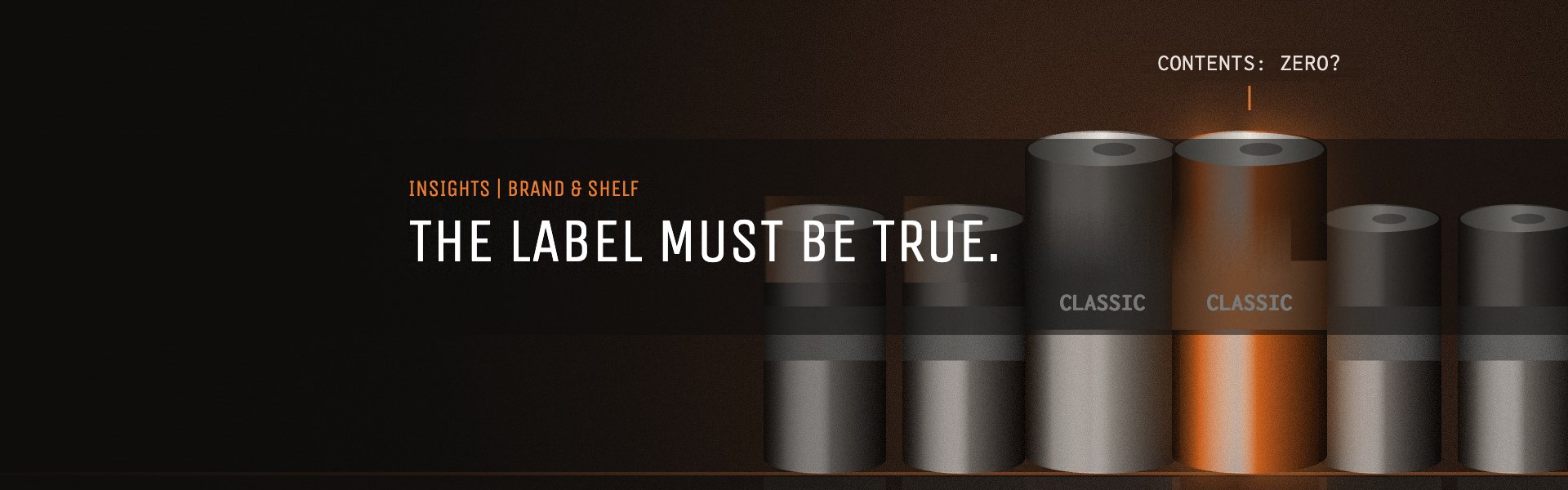
- The promise is unclear. The brand knows what it can do – but the label doesn’t say it. If the pack lists five benefits at once, none of them sticks at the shelf. A product needs a reason, not a list.
- The price doesn’t explain itself. A higher price isn’t a problem if the difference is visible. Without that explanation, promotions become a habit and the regular price the exception. A YouGov analysis shows how far this has already gone: in 2024, retailers generated almost a third of their sales of branded products through special offers (also according to Lebensmittelpraxis).
- Brand and sales tell two different stories. Marketing positions on quality, the annual negotiation with the retailer revolves around terms, and a discount sign hangs at the point of sale. Each of these decisions makes sense on its own. Together, they don’t add up to a clear picture.
That sounds unspectacular. But in our experience it is exactly this lack of alignment that drains the strength of good products at the shelf – more than a few cents on the price.
FOUR QUESTIONS BEFORE PLANNING FOR 2027
Many manufacturers are currently preparing annual negotiations, promotion calendars and budgets for 2027. A good moment for an honest stocktake:
- First: the shelf sentence. Can you say in one sentence why someone should reach for your product at the shelf – and is that sentence visible on the pack?
- Second: the promotion logic. Which promotions build the brand, and which only train shoppers to wait for the next discount?
- Third: the shared roadmap. Do marketing, key account management and field sales work with the same arguments – from the annual negotiation to placement in the store?
- Fourth: the outside view. When did you last see your product on the shelf next to the alternatives, the way shoppers see it?
These questions are no substitute for market research. But they quickly show where there is room to manoeuvre.
STRATEGY AND DELIVERY BELONG TOGETHER
In our Sales & Retail practice we start with clarity: what does the product stand for, for whom, and how does that become visible at the shelf? This gives us guardrails for pricing, promotions and the arguments used with retailers. We tackle delivery together with partners who are at home in these areas – such as i solutions & more for field sales, promotion and point of sale, or Augur Pro for sales and B2B sales.
Our recommendation: don’t start with the discount, start with the reason your product deserves its place on the shelf. In our experience, if you formulate that reason clearly and carry it consistently through brand, sales and point of sale, you need fewer promotions to be seen. Let’s spend 30 minutes talking about your shelf.