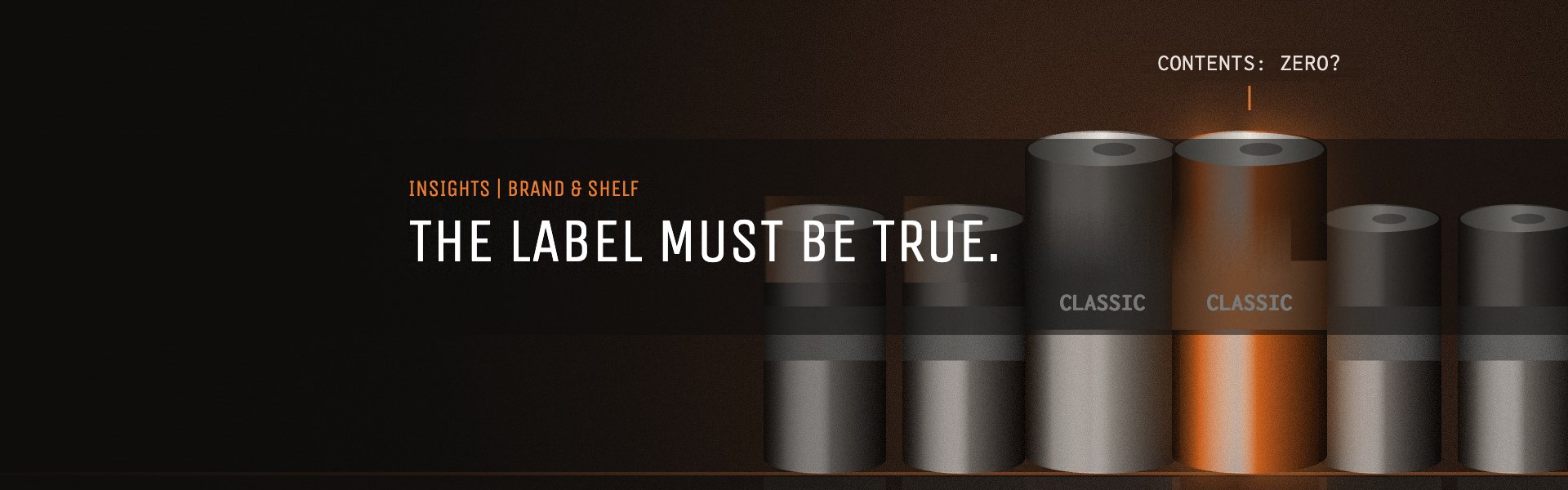
WHEN WHAT’S INSIDE ISN’T WHAT’S ON THE PACK
It says Sprite Classic on the can. Inside is Sprite Zero. Since 19 November, Coca-Cola Europacific Partners Deutschland has been recalling 0.33-litre cans of Sprite Classic in the NBA promotional design with a best-before date of 30 April 2027. According to the company, a production error meant that sugar-free Sprite was filled into cans intended for the sugared variant (WELT, dpa-AFX).
For most people, this is a curious news item. For people with diabetes who count on the sugar in the can, it is a real risk. And for every brand that sells in packaging, it is a reminder of something that is easily overlooked in day-to-day business.
PACKAGING IS A PROMISE
Nobody checks the contents at the shelf. People trust what it says on the pack. That is exactly why a packaging error never affects only production – it always affects the brand. In the Sprite case, according to the manufacturer, the error occurred during filling. In many companies the risk lies earlier: in the question of which artwork applies to which variant and who last approved it.
FIVE LESSONS FOR BRAND MANUFACTURERS
- Packaging speaks for the brand. Whether the error happens on the production floor, in design or in master data, customers experience it as a brand problem. That is why packaging is as much the responsibility of marketing and product management as of production.
- Variants are where everyday risk lies. Classic and Zero, standard and special edition, Germany and export: every variant is an opportunity for a mix-up. The more variants you have, the more important a single source for every artwork becomes.
- Special editions need the same care as the core range. Promotional designs are created under time pressure, often with different people involved. One detail is instructive: the striking promotional design makes the affected cans easy to recognise and the recall therefore easy to narrow down.
- Good crisis communication is narrow and specific. Size, design, best-before date, where to check, how to return: informing this precisely stops uncertainty from spilling over to the entire range.
- Preparation determines speed. If you only start looking for where packaging data and approvals are stored when a crisis hits, you lose days.
THREE QUESTIONS FOR YOUR PORTFOLIO
- First: the overview. Do you know how many packaging variants you have on the market – and who last approved each one?
- Second: the single source. Are artworks, mandatory information and approvals kept in one place, or scattered across inboxes, agencies and printers?
- Third: the emergency plan. Who decides on a recall in your company, and how quickly can you reach retailers and customers?
These questions are no substitute for quality management. But they quickly show where your packaging process is vulnerable.
STRATEGY AND DELIVERY BELONG TOGETHER
In our Sales & Retail practice we start with clarity: where are the risks in your packaging process, and which parts do you hand over to whom? For delivery we recommend our partner mds. Experience & Packaging. The team thinks about packaging beyond print approval: packaging design and design systems across product lines, variants and countries, more than 15,000 artworks a year checked before anything goes to print, colour and print quality through to final sign-off, localisation with mandatory information for more than 40 country markets, and a web centre with approvals for each document. One point of contact from brand to shelf.
Our recommendation: don’t wait for a crisis to get to know your variants. If you know today what is on every pack and who approved it, you will still be able to act tomorrow. Let’s spend 30 minutes talking about your packaging variants.